Our Biggest Update Yet: Rebuilding The World While Tech Giants Flounder


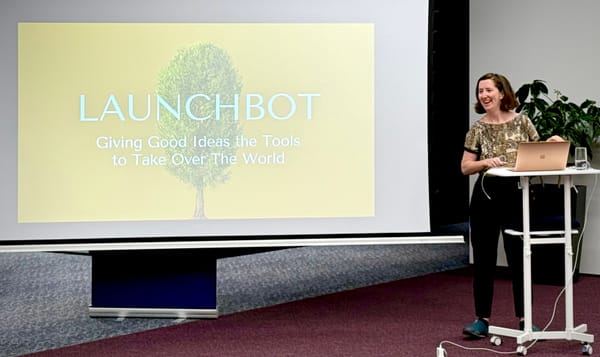
I'm Maddy King. I work in AI and social impact as founder of Launchbot, helping grow a bunch of social enterprises, nonprofits, startups and businesses. I'm very interested in how we can use tech to build the better world we all know is possible, so this is maybe-regular roundup of things that spark ideas and reinforce that the future isn't written yet – we're writing it.
Massive news. Launchbot's Ads Manager is here!!!!
What does this mean? And why am I so excited!
Social media infrastructure is the most powerful tool in history that we have available to us to grow a good idea. The tech giants that control massive social media have demonstrated pretty dubious ethics, and one approach is to opt out entirely. Launchbot’s trojan horse approach is to intentionally use social media as a ladder to grow your good idea - without handing over your wallet to tech giants.
Up until now Launchbot could create a detailed profile of your most engaged community members or customers, and tell you how to update your website or generate content to find and engage more of them.
Launchbot's brand new Ads Manager means with just a couple of clicks, you can now turn that content into a Meta ad that uses Launchbot targeting to reach more people for a fraction of the cost - so you can put those resources back into the impact you want to create. Check out this funny video where I try it out for the first time:
What's unbelievable is that in this test Launchbot is bringing in better results that I achieve manually as a growth marketer with over a decade of experience.
Launchbot just changed the game.
That's achieving the same impact while giving Meta significantly less resources.
So if you spend money on ads, think about your ad spend for the past month and imagine what you could do if you got the same results for a fraction of the price.
If you don't run ads, think about whether your organisation would benefit from reaching hundreds or thousands of the right people. If it's in line with your values, Launchbot can handle the ads for you - and ensure they're targeting the exact right people to grow your biggest supporters.
These are just preliminary results, but I'm incredibly excited to release the new tool out into the wild and see how it helps your good idea grow!
Treat yourself
Give it a go for free now and let me know what you think! I'm really interested to hear what results you get. And forward this on to a friend who is getting demolished by Meta ads since the algorithm update.
Join the Webinar
I'm running a webinar on the ads manager at 12pm NZT this Friday 17th October and I'd love you to come! I'll walk through the steps to create a hyper-effective ad, and answer any questions:
Otherwise book in a time here and I'll give you a personal demo.

Launchbot releases AI Mitigation Calculator
Launchbot has released a free tool to help you calculate and mitigate your AI emissions.
It calculates your emissions based on your AI use, then partners you with the fantastic nonprofit Trees That Count to plant trees for you for $10 NZD a tree. This process is really fun, because Trees That Count tell you exactly where your tree gets planted! Mine got planted right next to my parents' town, so I'll be able point to it next time I go and visit.
And because mitigating isn't enough, it also helps you donate to Climate Club Aotearoa to tackle the problem of rising emissions. And it also suggests lower-emissions AI models you could try.
Most businesses only need to plant 1-2 trees a year to mitigate their AI load. That's only $20.
Mitigate your emissions here - takes only 5 minutes.
In the world of AI, Rebellion and Social Impact:
- Gen Z is overthrowing governments
Nepal. Madagascar. Morocco. Leaderless. Organised online. Refusing to accept futures written by corrupt politicians. They're not asking for reform, they're demanding replacement.
- Women are rebuilding AI outside the broken system
Mira Murati. Fei-Fei Li. Daniela Amodei. Daphne Koller. Instead of waiting for improvement, they're building alternatives.
- The planet's repair is being crowdsourced
150 million oysters. Concrete batteries. Underwater data centers. None of these are government programs. They're people and organisations deciding the future won't wait for institutions to act.
And Jane Goodall died, leaving us with this: we each make an impact every single day, and we get to choose what kind.
In More Depth:
Gen Z anti-corruption protests are sweeping the world.
Youth-led protest movements in Nepal, the Philippines, Indonesia, Morocco and Madagascar are learning from previous protests that toppled governments in Bangladesh and Sri Lanka in recent years. Around 50% of the people in these countries are younger than 28. The uprisings have inspired people toward political action and led to violence, reprisals and death. Protestors have been calling out corruption and mobilising hundreds of thousands of people into the streets using the viral mechanisms of TikTok, Reddit and Discord. Nepal and Madagascar's governments have collapsed without a leader or political party to replace them - just a generation that is refusing to accept a future written by corrupt politicians.
What this means for your project / business / movement:
- Youth are the drivers of social change. They have massive social exposure, the world's greatest FOMO and incredible herd dynamics. They are also less likely to accept that there are things they can not change.
- If your cause doesn't reach, speak to or engage Gen Z, it's not likely to be durable.
- Hire a youth and don't just ask them to make reels! Ask them for ideas. You'll be amazed by what happens.
A self-driving Waymo got pulled over for doing an illegal U-turn
The future is here. A police officer in Phoenix pulled over a driverless Waymo for an illegal U-turn and then didn't know who to issue the ticket to. The car? The company? The universe?
Mira Murati and the women rebuilding AI from scratch
Mira Murati was OpenAI's CTO, overseeing ChatGPT and DALL-E before leaving in 2024. She's now solved one of AI's major problems: giving different answers every time you ask the same question. This is called "nondeterminism" and experts thought it was unfixable. She fixed it.
Mira Murati is 36. She just left the most influential AI company in the world to compete with them. And she's not alone.
Fei-Fei Li, who revolutionised computer vision (the basis of AI image detection and recognition), left her role as Chief Scientist of AI/ML at Google Cloud to return to Stanford and lecture on AI accessibility and fairness. She's now founded World Labs to build AI with spatial intelligence.
Daniela Amodei left her role as OpenAI's VP of Safety and Policy to co-found Anthropic and build Claude AI. Amodei is Anthropic's President, building AI systems with principles baked in.
The pattern is brilliant entrepreneurs building groundbreaking tech at major institutions, realising those institutions will never give them full creative freedom, leaving, and building companies that challenge the giants they left behind.
This is what optimism looks like. Not staying at the table hoping for scraps. Building your own table.
What this means for your project / business / movement:
- If the existing power structures won't change, create competing structures that make them obsolete.
- There's often a tradeoff between times when you're "learning" and times you're "doing" at work. If you're achieving neither, sometimes best thing you can do is leave and build your own version.
- Women have always been leaders in tech and are presently at the helm of AI. Watch out world.
Who still uses printers? The 1990s just got thoroughly disrupted
Printers have got to be one of the most frustrating pieces of technology in existence. They only work when you don't need them. They claim to be out of cyan when you're printing in black and white. I haven't printed something since 2012, but printers have been conspiring against humanity since the first HP DeskJet emerged from the cursed depths of 1988.
French company Open Tools is crowdfunding for an open source printer that you can repair and refill to your heart's content. It will finally end the naked exploitation of printer companies that give away the device and then charge $3,000 per drop of ink. It's just potentially come 3 decades too late.
AI can read the thought patterns of mice by watching their faces
Scientists have been able to use machine learning on mouse videos to determine which subtle facial expressions were predictive of different problem-solving strategies the mice were using.
Specific facial movements correlated with specific thought patterns, and this correlated across different mice. This means videos aren't just mementos anymore – they're detailed windows into brain activity. If ML can read a mouse's thoughts from its face, how long until it can read yours?
What's the worst way this could be used?
- To read customer reactions, employee engagement, student comprehension, voter preferences, anti-government sentiments.
- Through your webcam, so surveillance capitalism can decide how to get you to spend more.
What's the best way this could be used?
- Detect people in distress who urgently need help but are unable to ask for it
Meta will mine your AI chats to sell you targeted ads
Need another reason to never use Meta AI? Starting December 16th, every conversation with Meta AI will be fed into their advertising machine. Ask about hiking? Get ads for hiking boots. The company promises conversations about health, religion, or political views won't be used (do you believe them?), but there's no opt-out. The only exemptions are South Korea, UK, and EU – places with actual privacy laws.
What this means for your project / business / movement:
- Trust is more valuable than data. As platforms burn goodwill by monetizing intimacy, there's massive opportunity for privacy-first alternatives.
- Build consent into your core architecture, not as an afterthought.
The Netherlands just told companies to stop hiding behind chatbots
Dutch authorities have warned organisations that they must offer people the option to speak with a human. Chatbots need to clearly identify themselves as non-human, can't provide evasive or incorrect answers, and cannot be the only path to support.
The Dutch Data Protection Authority described chatbots as "one of the biggest annoyances" customers face after seeing a "rapid increase" in complaints.
It's one of the first regulatory pushbacks against the "automate everything" mindset, and could be a signal of things to come.
150 million oysters are cleaning New York Harbor
The Billion Oyster Project has restored 150 million live oysters to New York Harbor. They've worked with over 100 schools, engaged 30,000 NYC students, recycled 3 million pounds of shells from restaurants, and mobilized 15,000 volunteers.
Oyster reefs provide habitat for hundreds of species and protect cities from storm damage by softening waves, reducing flooding, and preventing erosion. The project's goal is to regenerate enough oysters to filter the entire harbour's water in just three days.
In 2014, this seemed impossible. Now they're 15% of the way there.
What this means for your project / business / movement:
- Education is a path to scale. By training 30,000 students as scientists, they created an army of passionate advocates for decades.
- Use what others throw away. Three million pounds of restaurant shells became habitat.
- Community-driven restoration works. You don't need a government program or corporate sponsor to rebuild an ecosystem.
- The impossible becomes inevitable when you start.
Neural responses predict friendship before you've even met
Scientists have been able to accurately predict whether people are likely to become friends in later life, based on whether their brains respond in a similar way to video stimuli.
This suggests adult friendships aren't just based on circumstance or shared hobbies. They're shaped by shared ways of seeing and interpreting the world.
MIT turned concrete into batteries (and your garage could soon power your house)
Researchers at MIT have figured out how to turn concrete into a battery by making it conduct electricity and then adding electrodes to create a supercapacitor. Now a garage wall can store enough energy to power a home's daily needs.
In addition, when they put stress on the concrete the power supply flickered. "We may be able to use this as a signal of when and to what extent a structure is stressed, or monitor its overall health in real time."
What are the implications?
- Buildings can become batteries. Solar panels on the outside and energy storage in the walls. Every home, office, and parking building could become energy storage infrastructure.
- Decentralised energy storage can change power dynamics (literally). Communities could generate, store, and share power without utility companies.
- Start reimagining your community as its own self-sufficient energy infrastructure.
What Does This All Mean?
The world is changing faster than institutions can adapt. Technology that seemed impossible five years ago is boring today. Giants are stumbling while scrappy teams solve "unsolvable" problems. Young people are toppling governments. Someone turned concrete into a battery. Oysters are cleaning harbours.
The future isn't written by those in power. It's written by those who refuse to accept the present.
What impossible thing will you make inevitable?
Thanks for reading. Let me know your idea shoots, shrubs and saplings. For more detail, context and updates on the above stories, check out the amazing Memia. If you found this helpful, please forward this to someone in your life who may enjoy it, or consider supporting with a coffee koha.